

Videos, webinars, quick-reference guides, and answers to common questions related to Nagios Network Analyzer.
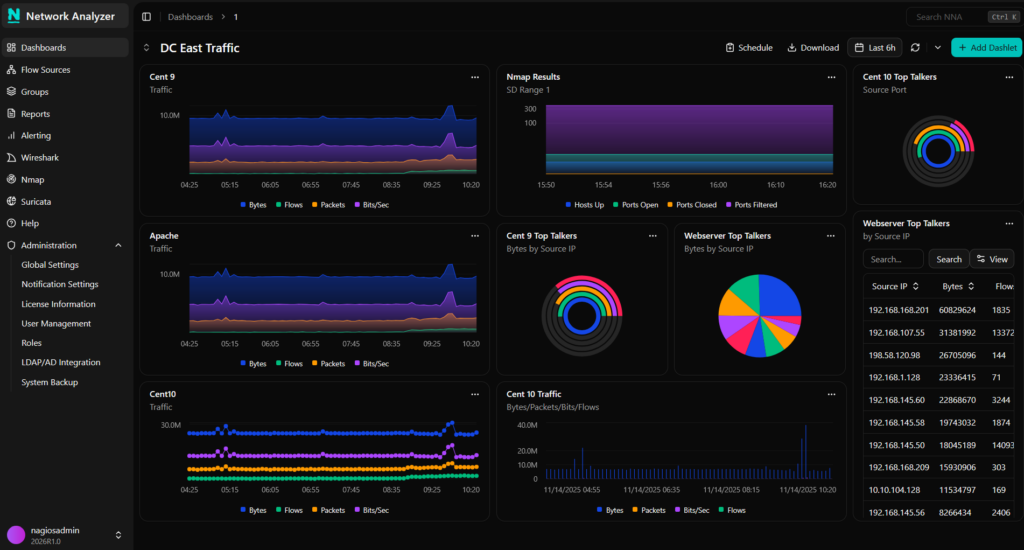
View tutorials for installation, configuration, administration, and dashboard management in Nagios Network Analyzer
Integrate Active Directory and LDAP servers with Network Analyzer for streamlined user authentication and management.
Configure notifications and create checks for flows, scans, security alerts, and system metrics in Network Analyzer.
Learn how to manually install Nagios Network Analyzer 2026 on a clean system.
Optimize your Nagios Network Analyzer deployment and learn how to troubleshoot your network in real time.
A complete overview of Nagios Network Analyzer, including a tour of the new capabilities and enhancements added in the 2026 release.
Quick tour of the Nagios ecosystem: Core, XI, Log Server, Network Analyzer, Fusion, CSP, and 2026 updates.
On-demand sessions covering deployment tips, best practices, and feature deep-dives from the Nagios Team.
Jump to a specific area of the Nagios Fusion docs on the library.
The most common questions from Nagios Fusion users and evaluators.
Have you ever asked yourself, “Where is all my bandwidth going?” If you want to see more metrics about your network than just how many bytes are getting shuffled around, you want Network Analyzer!
Being able to determine exactly which IP addresses are contacting your server and hogging your bandwidth is extremely valuable. Network Analyzer keeps a record of all internet traffic information and allows you to see exactly who connected to your server on a given port and actually get answers.
Sample use cases include capacity planning, intellectual property security and corporate data leak protection, security breach and unauthorized access detection, virus and malware detection, setting QoS baselines, and more!
Yes! Our 30-day evaluation copy lets you test Network Analyzer before you decide to purchase. You can purchase a license key at any time, and your Network Analyzer instance will be changed to a non-expiring version.
During the trial period, you’ll be able to upgrade your Network Analyzer installation with the latest patches to ensure you have access to the latest features.
The Network Analyzer system is comprised of two categories of licensed code:
The Network Analyzer UI and system frameworks are released under a commercial license and contain some code used under license by Nagios Enterprises that cannot be released under an OSS license. Purchasing a Network Analyzer license grants you a perpetual license to use the Network Analyzer UI and system frameworks, including the licensed code.
Network Analyzer is supported by our team of professionals. Each purchase of a Network Analyzer license provides customers with access to ten (10) support cases per year through the Answer Hub. Access to this premium support portal also includes Knowledge Base resources.
If your organization exceeds the number of support cases included in the Network Analyzer pricing, you may purchase additional support case packs. Optional phone support packages are available to ensure your team has priority access to assistance when you need it most.
Yes! Manual installation of physical servers is recommended. The server must be RHEL or CentOS. We also distribute Network Analyzer as a virtual machine to allow you to get it up and running quickly.
If you need to reset the nagiosadmin password, follow the step-by-step instructions in the official guide below.
No. Network Analyzer does not show you that information.
It will show you how much information went between two computers, average size in bytes per packet, and lots of other similar information, but it will not tell you the content of the traffic. Network flow data keeps track of who was talking to whom on what port and protocol and the amount of data sent, but not the content of the conversation.
Yes. Network Analyzer requires that ports be opened to allow network flow data to be delivered. The ports that need to be opened are determined by the administrator when setting up Network Analyzer to receive the flow data. They will use one port per source they are receiving flow data from.
If you want to receive network flow data for a device and do not have a router with network flow data capabilities, then yes.
This is totally up to the user, but the default is 24 hours.
However, when the user creates a new source, they are prompted to specify how long they desire to store their data for. This can be for as long as the user desires, but keep in mind that network flow data technologies take up a large amount of disk space. Not only that, but the extra parsing through the files puts unnecessary strain on the CPU if users don’t care about information but are still keeping it.
Troubleshoot with this article on no data available error.
Yes! Network Analyzer has out-of-the-box integration with Nagios XI and can send results to Nagios Core. Network Analyzer can also send email alerts and SNMP traps.
Follow the troubleshooting steps outlined in the My New Source Won’t Start article.
Yes! Network Analyzer can perform DNS resolution of host names (such as Facebook or YouTube) and will allow you to abstract your queries in that fashion.
The initial purchase of any of our commercial solutions includes the first year of license benefits. These benefits allow customers to access version upgrades for one year, submit up to ten support cases, and access the Answer Hub.
Network Analyzer can integrate with Nagios XI to provide you with a view of Network Analyzer’s comprehensive reporting and who is communicating with any server on your network from within the XI system.
No questions match this filter.
Our professional technicians will assist you with getting started by helping with the setup and monitoring of your devices and network within your new installation.
Get a dedicated, one-on-one knowledge transfer service designed to provide direct expertise from our senior technicians.
Our team can help you find the right fit for your environment, get clear pricing information, answer technical questions, or set up a live demo.
An active Maintenance & Support plan connects you directly with our engineering team and unlocks a full suite of resources to keep your monitoring environment healthy.
Already have a license? Renew here